Neighborhood Security Teams
World War ZNeighborhood Security Teams are a part-time volunteer service created to patrol residential districts during the crisis and its aftermath. Their importance lies in the scale at which they operate: while armies confront the larger war, NST members inspect individual houses, monitor streets, respond to signs of undead activity, and help make devastated communities habitable again. The organization therefore transforms neighborhood familiarity into a form of defense, while also revealing how emergency institutions can either reproduce exclusion or become instruments of inclusion.
Nature and Organization
Neighborhood Security Teams are described as a quasi-military outfit rather than a conventional army or police force. Members attend lectures and training courses, serve under designated leaders, and follow fixed regulations, but they do not salute or use formal military titles. The arrangement is deliberately part-time, allowing volunteers to continue essential civilian work while serving at home. Their structure reflects a society in which ordinary routines have not disappeared so much as been militarized.
The program’s equipment is similarly improvised and local. Early teams rely mostly on hand-to-hand weapons, including hatchets, bats, crowbars, and machetes; the heavier Lobotomizer weapons have not yet arrived. At least three people in each team must carry firearms, while Joe Muhammad uses an AMT Lightning, a small semiautomatic .22-caliber carbine whose minimal recoil allows him to fire without locking his wheelchair in place. Once ammunition becomes standardized and reloads remain available, the weapon becomes a practical tool rather than a symbol of exceptional firepower.
Recruitment and Inclusion
Joe Muhammad’s recruitment exposes the tension between formal emergency policy and social assumptions about disability. A recruiter initially tries to dissuade him, asking whether he has consulted the NRA representative and pointing toward other essential war work. Her eyes repeatedly shift toward his wheelchair, making clear that the obstacle is not his willingness or knowledge but the institution’s uncertainty about whether a disabled volunteer can perform armed neighborhood duty.
Joe rejects that assumption by appealing to the actual design of the program. NST members patrol their own neighborhoods on foot or, in his case, by rolling along the sidewalk, stopping at each house to check conditions. If a patrol has to enter a building, at least two members remain outside in the street. Joe argues that the undead do not require volunteers to chase them over fences or across backyards; they come to the defenders. If a person who cannot move faster than a walking zombie could not survive, he reasons, he would not have survived this long. He refuses to leave until the recruiter obtains authorization, shouts loudly enough to draw every eye in the room, and receives his orange vest that same day.
This episode makes the organization’s inclusion more than a gesture of sympathy. Joe is not accepted because his disability is treated as inspirational or tragic. He is accepted because he demonstrates that the neighborhood environment and the team’s procedures can accommodate his body. The scene contrasts a narrow, medicalized idea of incapacity with a social and operational understanding of ability: the relevant question is whether the task has been designed intelligently, not whether every volunteer resembles an able-bodied soldier.
Patrol Methods and Daily Work
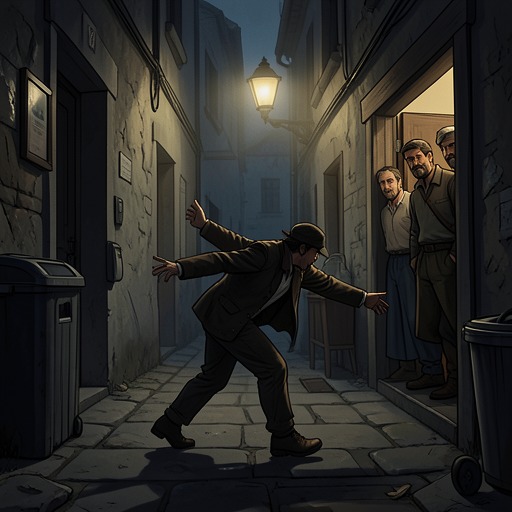
Team assignments change according to members’ schedules, partly because the Department of Strategic Resources is continually reorganizing the national response. Night duty is particularly difficult. Without streetlights, with few functioning house lights, and with the population going to bed soon after dark, entire neighborhoods become nearly black. Smoke and atmospheric debris obscure the moon and stars as well. Patrols therefore carry ordinary commercial flashlights, still powered by available batteries, with red cellophane over the ends to protect night vision.
The basic procedure is repetitive by design. Teams stop at each residence, knock, and ask the person on watch whether everything is secure. The early months are unsettled because resettlement continually changes the population: a patrol may encounter at least a dozen new neighbors or housemates in a single day. The organization consequently serves as both security network and civic registry, helping distinguish legitimate residents from squatters or looters while keeping track of a population in motion.
At home, the new rules require someone to serve as a designated night watchman. In Joe’s neighborhood, the names of household members are written on lists so patrols can verify identities, check faces, and ask whether the night has been quiet. Reports of unexplained noise lead the team to investigate. By the second year, refugees have largely stopped arriving and residents know one another well enough that lists and identification checks become unnecessary. The gradual abandonment of those measures marks a movement from emergency surveillance toward ordinary communal trust.
Encounters with the Undead and Other Threats
A central NST responsibility is clearing deserted houses. Many properties are shot up, broken into, or simply abandoned with their doors standing open. Teams place police tape across doors and windows; if the tape is broken, the damage may indicate that an undead person is inside. Patrol members wait outside with rifles while others enter. The work may end in shouted warnings, gunfire, or the quieter evidence of scuffling followed by a teammate emerging with a bloodied hand weapon and a severed head. Joe personally kills several undead during these operations.
His wheelchair becomes an unexpectedly protective object during one house-clearing operation. The team is searching a two-story, four-bedroom, four-bathroom house partly collapsed after a Jeep Liberty drove through the living-room window. While Joe is distracted by activity inside, a legless “dragger” approaches from behind and pulls at his chair. The chair gives him roughly a second and a half to swing his flashlight and bring the carbine around. Had he been standing, the creature might have seized his ankle or bitten him. The incident changes his conduct: it is the last time he treats his watch casually.
The undead are not the only danger. Looters and squatters also move through the damaged districts, although they are presented less as hardened criminals than as people trying to obtain necessities. NST responses usually end without violence. Teams invite such people into their homes, provide what they need, and care for them until housing officials can intervene. This practice places armed force beside hospitality, making the organization a mechanism for absorbing displaced people rather than merely policing them.
Social Function and Narrative Significance
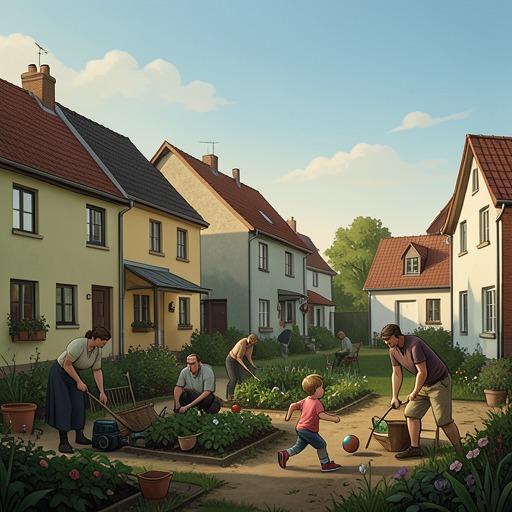
The Neighborhood Security Teams emerge from a landscape of mass movement, fear, and institutional collapse. Refugees arrive from resettlement camps; houses stand empty; roads are jammed with vehicles and pedestrians; and public authority is still being reconstructed. Against that background, the NST program gives citizens a manageable duty: patrol the block, inspect the house, identify the resident, respond to the noise, and stand watch while others sleep.
Its most important achievement is the conversion of strangers into neighbors. Joe initially describes his suburban life as sheltered and excessively comfortable, questioning the need for a three-thousand-square-foot house in which he had lived alone for years. Then a family of six from Alabama arrives with a letter from the Department of Housing. The arrangement is unnerving, but the Shannons become companions, and Joe sleeps better knowing that someone is standing watch. The same policy that disrupts private property and old habits creates a shared security arrangement.
The organization also dramatizes the difference between collective panic and collective action. Elsewhere, misinformation, sensational reporting, refugee flight, and religious delusion turn fear into denial or violence. NST work proceeds in the opposite direction: it reduces an overwhelming catastrophe to repeated, verifiable practices. A broken strip of police tape, an unfamiliar face, a report of movement in the bushes, or a knock at a door becomes actionable information. In this sense, Neighborhood Security Teams represent reconstruction not as a triumphant proclamation but as thousands of disciplined encounters through which a damaged society learns once again how to live together.